Millions is a new lottery proposition from Betfred, designed to give customers more control over how much they spend and how much they can win.
Unlike a traditional lottery ticket, customers can choose an entry price between 1p and £5, with prize available dependent on their entry price and how many of their six chosen numbers are matched from the daily draw.
I led the product design from early proposition through to production, focusing on making a new betting concept feel familiar, easy to understand and second nature for customers to place a bet.

The bet placement user journeys on existing Betfred Lotteries had become a convoluted process due to years of patching micro problems and adding new features. As an example, the Lucky Dip placement required the user to navigate through a 14 tap process to get from the draw homepage to bet confirmation. As a result, conversion was 7% compared to 49% when a customer picked the numbers themselves.
User interviews helped explain what we were seeing in the quantitative data. Users were giving up, dropping off, and not returning. Participants also validated assumptions that at the point of placing the bet, it is not clear enough that adding multiple entries for consecutive draws increases the overall entry price.
The biggest challenge was balancing flexibility with simplicity, giving customers more control over entry price without making Millions feel more complicated than the mass market lottery products they already understood. Clarity was key.
Due to low capacity in the design team, I was also responsible for delivering the design for a complete restructure of the Casino product. While leading the design for two product roadmaps, I had to manage double the meetings, double the ceremonies, and double the deliverables.

I reworked the user flow around a smaller number of consistent interactions, allowing customers to move between their own numbers, Lucky Dip and Favourite Numbers without creating separate funnels for each.
I introduced a Prize Calculator to allow customers to immediately understand how the variable entry price affected the prizes available to them.
I used Claude to build a high fidelity prototype to test the key journeys in the flow, focusing on comprehension, number selection, Lucky Dip, Favourite Numbers, draw selection and the Betslip.
Participants found the core experience simple and easy to navigate, with the Prize Calculator and number selection amongst the strongest parts of the journey.
Testing exposed more uncertainty around managing multiple entries, editing draws, Lucky Dip regeneration and understanding the total cost within the Betslip.
I used these findings to iterate the experience, making the relationship between entry price, number of draws and line cost more explicit while simplifying how customers edited and managed their entries.
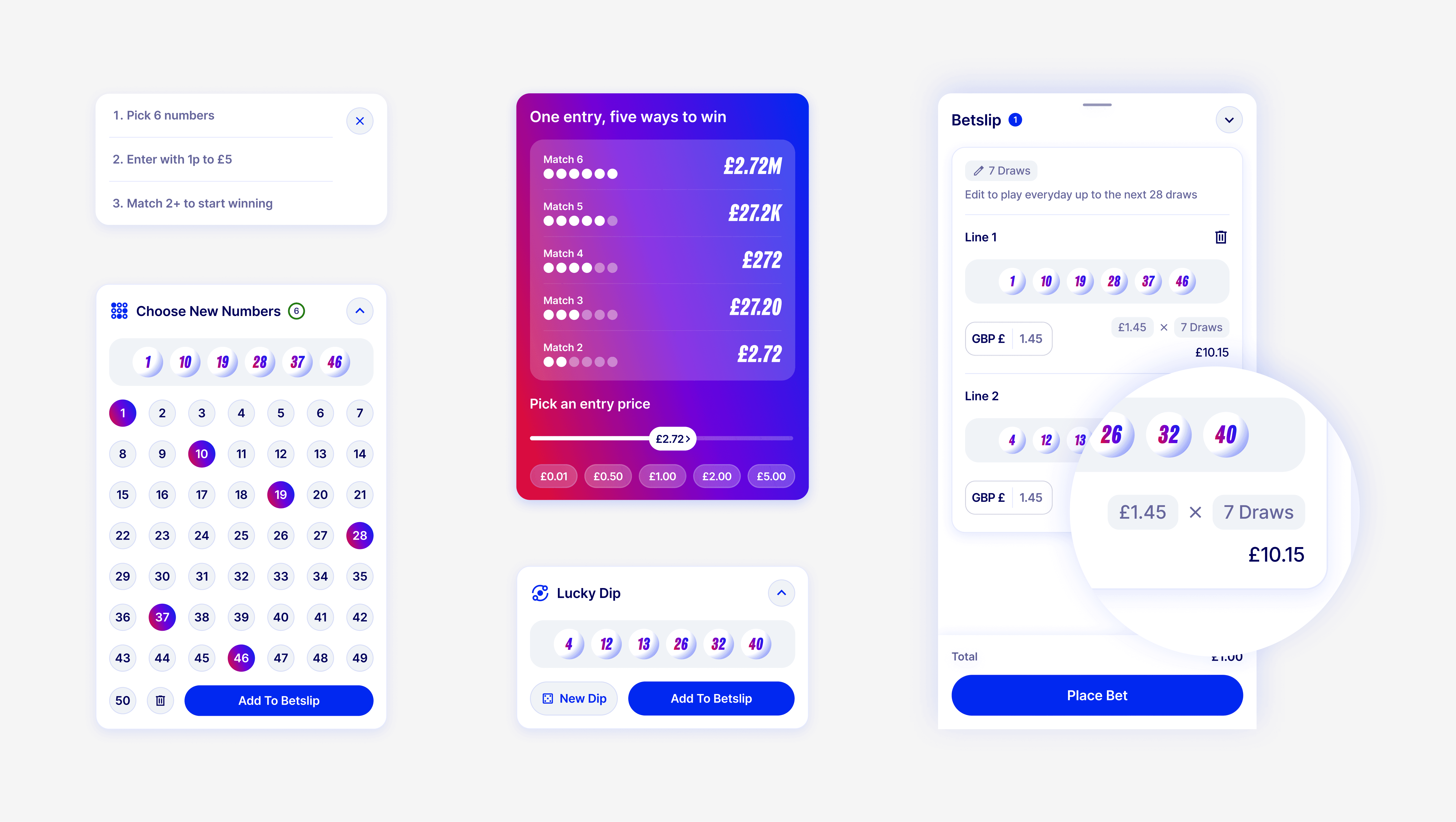
Customer testing validated the core proposition, with participants consistently describing the experience as simple, clear and easy to navigate.
Participants understood the relationship between how much they chose to spend and the prizes available, one of the biggest risks in introducing a flexible lottery proposition.
The Prize Calculator gave customers a simple way to explore the proposition rather than relying on instructional content to explain how it worked.
The findings from testing the bet placement experience have helped to inform the design direction for the betslip within the sportsbook, driving conversations to harmonise the betslips into one cohesive Betfred bet placement experience.
The coded prototype became a shared product artefact across the project. It allowed customers to experience realistic journeys in testing, gave senior stakeholders something tangible to review during sign off, and provided engineering with a working reference during development.
Millions is now in development ahead of its planned November 2026 launch, with marketing investment committed to support the product as it enters the mass market lottery proposition.
AI prototyping has been pivotal in validating with users, updating stakeholders and providing the source of truth for developers.
Millions reinforced the importance of testing whether customers understand the mental model behind a product, rather than simply whether they can complete a journey.
The individual interactions were familiar, but the challenge was connecting them to a new proposition. Customers needed to understand how their entry price affected their potential prizes, while still feeling like they were playing something recognisably lottery.
Testing the complete journey with a coded prototype also exposed problems that weren't obvious when looking at individual screens or happy path prototypes. The early experience performed strongly, while complexity began to build as customers added multiple entries, changed draws and reviewed the final cost of their bet.
That insight shaped the later iterations and reinforced how I work today. I try to make the consequences of a customer's decisions clear at the point they make them, particularly when designing products where flexibility can easily become complexity.
Made in the North West, UK